
By Anushka Singh
Abstract
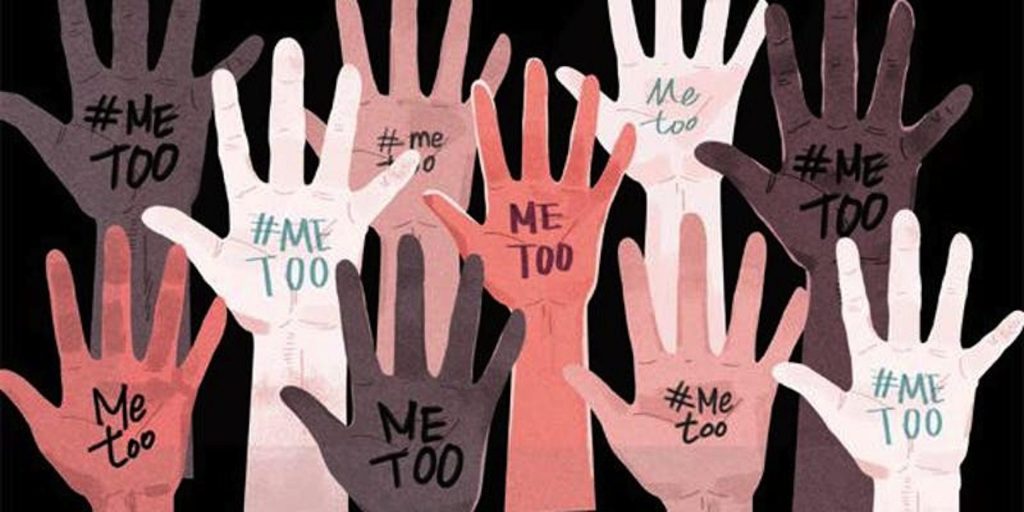
This article analyses the role played by caste, class, and patriarchy, in terms of the well known #MeToo movement. Further, it discusses, LoSHA and its significance in relation to the movement. Such movements are extremely important in the fight against Sexual harassment. Further, it rekindles the relevancy of the #MeToo movement. The paper gives an idea of how starting a movement is not enough we must also be aware of the nuances. Caste, class, and patriarchy will always play a part in such movements, but the fight is also against these concepts.
Introduction
The #MeToo movement was started by Tarana Burke, an African-American woman to help
raise awareness about sexual assault and to help survivors speak up. This movement helped initiate legal proceedings against Harvey Weinstein a Hollywood film producer. On the other hand, in India, there is a Dalit Queer PhD Scholar by the name of Raya Sarkar who put together a List of Sexual Harassers in Academia (LoSHA) on Facebook in October of 2017, with a similar aim.
As we all know #MeToo gained a lot of traction all over the world but LoSHA did not. In 2018, #MeToo gained popularity in India as it was brought to the country by Bollywood celebrities. The Indian component of the movement can be added to the list of other movements such as the Pinjra Tod movement and Bekhauf Azadi. The former is a movement started with the intention of retaliating against the sudden imposition of curfew in girls’ hostels in Delhi. The latter was a movement with the motive of women to reclaim their right to move around freely in the city at night. At the core, all movements have one thing in common. That being, the urge to reclaim public spaces and not be afraid. “The ‘sharing’ of survivor stories has served as a means to challenge the taboo of victimhood and create a possibility for solidarity.” (Pan, 2023)
The movement and the list; why it failed?
#MeToo was started by an African-American woman. As we know it became a revolutionary movement. However, she was hardly given any credit for the trend, presumably because she is an
African American woman residing in America. Consequently, Raya Sarkar who is a Dalit woman tried to come up with this List of Sexual Harassers in Academia (LoSHA) it did not gather that much attention and quickly died down. It is claimed that this is because it was a Dalit woman who started this and the society we live in is not very inclusive. Sexual harassment is something that a majority of women have faced. Despite this, it is usually upper-caste women who end up dominating discussions of sexual harassment. As mentioned before, when LoSHA was released it did not pick up but when Bollywood actress Tanushree Dutta used the #MeToo and shared her experience with sexual harassment it took Twitter by storm.
The society we live in does not want to hear cases of people who are oppressed already. Having a Dalit woman share something like this could change certain power dynamics, therefore, it could be seen that this was one of the reasons it was not so popular. Dalit, Bahujan and Adivasi women are some of the most vulnerable groups of people to such crimes that have been the main focus of these movements.
Caste and media attention
Lower cast/class women have been suffering in silence. Further, they argued that despite the limited access to the internet in India, digital spaces are still more accessible than offline spaces for many people. As a list of caution made publicly available for students to protect themselves from predators in academia, LoSHA wrested power from institutional forms of justice to center the narratives of survivors and provide a sense of closure to “women who have suffered through trauma in silence” LoSHA thus, became a radical act of “talking-back” to these legal-institutional forms of justice, which have often worked “to silence survivors, protect predators, and perpetuate systemic oppression” (Sharma, n.d.) Kashmiri women and North Eastern women were also inspired to share the stories of sexual violence committed by the Armed Forces due to the immunity they got because of the Armed Forces Special Powers Act, of 1958 which made the government turn a blind eye towards these oppressed women. It made the armed forces more accountable.
Usually, one of the major features of any movement is the relatability or identity. People of historically oppressed communities do not have as much access to the internet as the people of upper caste communities. Therefore, it is harder for a Dalit woman to gain support than it is for a Brahmin or Kshatriya woman. The support she would have gotten would be because of women supporting women but it was not enough. In India, “we have seen that when a Dalit, OBC, or Adivasi woman comes forward to share her experience of harassment, she is often asked by members of her own community to not take the complaint forward or to seek punishment for the perpetrator or face backlash within the community.” (Ditlekha, 2018) The #MeToo movement gained traction in India, in 2018. Prior to this, a gruesome case of rape had taken place in India. The ‘Nirbhaya’ case, gained the attention of all media houses and the public. Why? On account of the fact, that “Nirbhaya’ was a middle-class woman of an upper caste residing in Delhi. The immediate relatability gripped the focus of the public. A majority of news consumers belong to a similar background. The public was able to relate with the family, and girls were able to identify with ‘Nirbhaya.’ It made them believe that it could happen to them as well, and this made them fearful. The fear and anger are what made the public come out on the streets and protest the same. Due to this, it became a nationwide issue, demanding government action. It led to the Criminal Law Amendment Act, of 2013. The Act changed several aspects of the meaning of rape. On the contrary, the ‘Kathua’ rape case was of a minor Muslim girl in the District of Kathua, in Jammu and Kashmir. The case drew the attention of the public. Protests erupted in Delhi. However, all of this was short-lived, despite occurring at the same time as the #MeToo movement. “It is clear that the more privileged voices are the ones that are heard the loudest right now, and this is a recurring problem when it comes to sexual harassment. The struggles of Dalit women, transgender women, and Kashmiri women find far less resonance,” (Najib, 2018)
Naming and shaming
Another reason why the LoSHA was cut short and could not gain its full support is that it was criticised for being nothing more than a list used for ‘naming and shaming.’ Although, indeed, there was not enough proof to support the names in this list, the list was targeting ‘men’ in academia. Unfortunately, we live in a patriarchal society, where men dominate. Especially, the fact that it was a Dalit woman who was targeting men who may be considered superior to her is something that will not be accepted by too many people. Also, the society is built in such a way that women who have been sexually harassed are the ones who are looked down upon and there are a lot of consequences that women have to face for no fault of their own. These movements have allowed women to tell their stories more freely without facing harassment by the police or any family members who stop them from reporting such incidents. The movement is just a way to make women feel that they are not alone and to help them gain the courage to come out and tell their stories without being afraid of the consequences. Women have shared their stories and narrated various incidents that they have experienced. Since, the onus to prove that these incidents occurred lies on the woman it helps when they share these incidents on social media so people who have had similar experiences with the same harasser can make a more solid case. It is harder for people to believe that women are lying about their sexual harassment experiences than for them to believe that a man has sexually harassed her. Making it harder for women to report as they feel like they will not be believed and will be shamed for trying to question the integrity of a man. Critics have challenged the movement by stating that this method is risky as these claims are sometimes not backed by enough evidence and can affect the accused (again they are mostly men.) It is also hard to hold the woman telling these stories accountable as many of the stories have been shared anonymously on social media platforms. This tries to take away from the main point of the movement which is to just empower women to tell their stories after suffering for so long and feeling alienated because of their experiences. Again this tries to take away the power from women to freely share their stories and feel empowered. The movement is trying to be shown as it is a movement against all men but that is not what the true intention is. Another thing that is a consequence of the patriarchy is that the Indian legal system does not fully recognise sexual harassment of men. Using social media platforms could be an easier way for men to share their stories. It has been three years since this movement not much has changed but the change is happening in the right direction. At least women have gained the confidence to push boundaries and tell their stories. without fear and judgement but there is still a long way to go.
Conclusion
Since India is a country that is so diverse in many ways it is hard to mobilise such movements and have the full support of such different groups of people. There is also a lot of importance given to who tries to mobilise the movement, and who the target is for the movement and the aim. There are many layers to these things. Due to the stratification of society based on class, caste and gender. Some hierarchies and inequities need to be taken into consideration when mobilising such movements. All said and done, the movement was overall a positive one that helped women and there were even some investigations taken up against some of the men who were mentioned.
Author’s Bio
Anushka Singh is a fifth-year student studying law at OP Jindal Global University.
Image Source: https://theleaflet.in/one-of-the-metoo-movements-in-india-the-list/
 NICKELED AND DIMED