
By Apurva Kandpal
Abstract
This article explores the history of abortion laws in South Korea and the 2019 Constitutional Court judgement that finally held the abortion ban unconstitutional. With the emergence of reproductive rights and feminist groups on the issue of abortion, the article delves into the longstanding struggle of the public and the social justice groups that ultimately resulted in the historic 2019 judgement in the country.
Introduction
On April 11, 2019, the Constitutional Court of the Republic of South Korea held the ban on abortion law in the country as unconstitutional. Joint Action For Reproductive Justice (Joint Action), a group formed by doctors, feminist groups, disability organizations, youth activists etc. in 2017 were the biggest advocates of the historic decision. The main argument that was brought forward by the group was to make the government aware of their responsibility of safeguarding every individual’s sexual and reproductive health rights and the fundamental right of self-determination. Until 2010, the issue of abortion was not considered an important one due to the enforcement of the anti-abortion law. There were government policies that encouraged abortions, contraceptives, and sterilization to reduce the nation’s fertility rates. But post-2000s, the government began implementing the abortion ban due to the significant decline in the country’s birthrate. As the number of prosecutions for abortions began rising, various reproductive justice organizations brought back the issue of sexuality and reproduction into the main public discourse.
History of Abortion in South Korea
Before the 2000s, the government established multiple family planning clinics around the country which provided abortion services under the name of menstrual regulation, despite the law still making it illegal. The enforceability rate of the anti-abortion law was as low as 5.6 cases per year. One of the major goals of the government was to reduce the fertility rate so that the country could receive international aid for economic development. The South Korean Family Planning program was an extremely successful project that significantly declined the country’s total infertility rate. But despite abortions being widely encouraged, women still had difficulties in getting abortions due to multiple reasons. Firstly, any woman who wanted to get an abortion was required to have the permission of her male partner. Secondly, as abortion was not legal, women still struggled to get access to good healthcare services and any information related to abortion easily.
When South Korea’s fertility rate started dropping too low, where at a point it reached 1.08 in the year 2005, which was among the lowest rate in the world, the government was quick to drastically change the population control policies in the country. They came up with Framework Act on Low Birth Rate in an Aging Society and also began enforcing the Criminal Act of 1953 within which Articles 269 and 270 criminalised abortion. The only exceptions to the articles were cases of incest, rape, severe genetic disorders, specific diseases, or threat to women’s health. The Ministry of Health and Welfare came up with the “Master Plan for the Prevention of Illegal Abortion” in 2005. Multiple abortion prevention policies were established to increase the country’s total birth rate. The government was very worried about the significant rise in the adult population while the youth population continued to decline. The youth were typically important for every growing economy and hence, the government came up with strict enforcement policies to prosecute anyone who went through illegal abortion and the doctors who conducted the abortions. Several women went to other countries for abortions. But the Koreans who were not financially stable did not have such an option with them. Many resorted to illegal and unsafe ways to have abortions. There were calls around the country urging the government to expand the grounds for legal abortion under Article 14 of the Mother and Child Health Act, to also include socioeconomic reasons. There was a tense and dangerous environment around the country where both the patient and the doctors were living in fear of prosecution.
Lifting the Abortion Ban
In 2012, the Constitutional Court upheld the anti-abortion statute, with 4 justices against the law and 4 supporting it. The court stated that “…it could not be said that the burden on women due to the abortion ban is more serious than the public interest, i.e. protection of the fetus’s life.” They did not find the abortion ban out of proportion when balanced against public interests. Finally, in 2019, the Constitutional Court lifted the ban with the Case on the Crime of Abortion. The court held the current law to be non-confirming with the Constitution, in a seven to two ruling. To declare a statute unconstitutional, more than six out of nine justices are supposed to agree with it. The seven justices declared the law to be violative of women’s right to self-determination, deriving it from Article 10 (protection of human dignity). But the court left the law in its place and ordered the Korean legislature to revise the law until the end of 2020.
When the court’s judgement came out in 2019 and the ban was lifted, there were multiple factors like changes in the political environment, progressive judges, shifts in the general public’s opinions etc. that lead to the final judgement. Articles 269 and 270 of the Criminal Act of 1953, which punished both mother and doctor for terminating a pregnancy, were held unconstitutional by the bench. The court’s decision was used as a reference point to create new discourses and develop new policies related to abortion in South Korea. In the judgement, three main implications that the court brought up were: a woman’s right to decide whether to have or not have a baby is a fundamental right guaranteed by the constitution and the right to self-determination includes a woman’s right to autonomously form her sphere of living based on her dignity. Second, women face socioeconomic burdens like gender biases, patriarchy, and poor childcare conditions hence banning abortions will not only be ineffective in reducing abortions but also harm women’s health and lives. Third, the court emphasized the duty of the government to implement and strengthen sex education, conduct counselling, provide social assistance to pregnant women and children, and resolve various institutional and social structures that impede childbirth and childbearing.
Reproductive Justice Movement
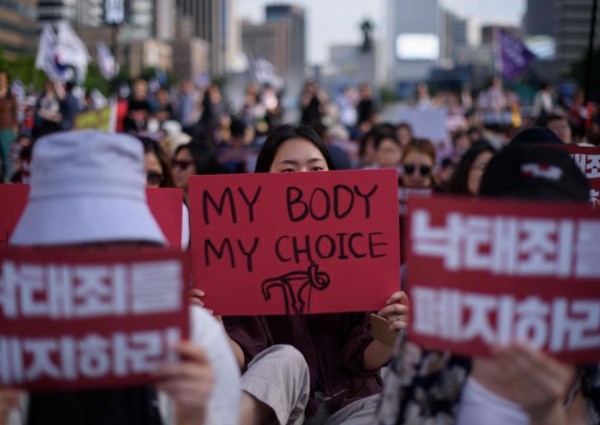
The Joint Action for Reproductive Justice, formed in 2017, expanded the discourse of reproductive and sexual rights around Korea. They managed to recruit progressive social justice organizations to collaborate on the issue of abortion rights for Koreans. Previously, the main discourse around reproductive rights was only confined to young, cisgender, heterosexual and able-bodied women but Joint Action wanted to include people of diverse identities into the movement like queer and transgender women, women with disabilities, women having HIV/AIDS, young girls and sex workers. The solidarity group urged government ministries, and activist groups to submit amicus briefs to the Constitutional Court which stated that the government should change the criminal codes on abortion intersect women’s rights. Joint Action organized large rallies in South Korea to spread awareness of reproductive rights and to force the government to decriminalize abortion. Their major demands from the government were that; first, fully legalize abortion for the safe termination of pregnancy, second, improve sex education and better access to contraceptives in the country, and third, guarantee reproductive right to Koreans without any stigma or discrimination.
After 4 years of the historic decision, the South Korean government have failed to come up with a new regulation that fully decriminalizes abortion. Although from the end of 2020, the statutes have lost their power to prosecute a person for abortion it is still an unclear issue. Not all medical practitioners are ready to perform abortions despite the judgement due to fear of prosecution as the new abortion law is still not introduced by the government. Six different representatives have put forward seven bills but neither of those has made it past the parliamentary subcommittee stage. The Roe v. Wade U.S. Supreme Court ruling on June 24th 2022, has made the situation even more unclear and complicated as it was part of the Constitutional Court’s argument for decriminalizing abortions in South Korea. The Korean public is still waiting for a new abortion legislation so that there would be no hesitancy and complications around getting abortions in the country.
Author’s Bio
Apurva is a third-year law student at Jindal Global Law School. Her areas of interest are gender studies, intersectional feminism, queer theory, and criminal law.
Image Source: https://www.asiaone.com/asia/south-korea-constitutional-court-rule-decades-old-abortion-ban
 NICKELED AND DIMED