
By Sunidhi Gupta
Abstract
The modern nation has often been associated with a specific gender or addressed with gendered metaphors that result in it being engendered to evoke a sentiment. Even India’s relationship with its citizens has been associated with that of a mother to its child including the emotional connection and reverence Indians hold for their motherland. But there exists an ironic dichotomy between where women are placed and how they are treated. This article envisions the same issues along with the concept of ‘Bharat Maa’ as India is recognized.
“Western dictionaries define secularism as absence of religion, but Indian secularism does not mean irreligiousness. It means profusion of religions.” As Shashi Tharoor points out, India is a heterogenous, multi-ethnic society that is a mix of cultures, religions, races, and sexes that divide it into various states on a linguistic basis. The maternal metaphor is the symbolic creation made on the production of national identity itself defined through religion, language, and culture in nation-building. ‘Bharat Mata’ or literally, the mother of India is an identity that is seen as the representative of all women in the country and hegemonized the idea of an ideal woman. She is seen as an upper-class and upper-caste woman in terms of iconography and semiotics, and other people of the society belonging to the margins of social hierarchy within production do not fit into this nationalist imagery.
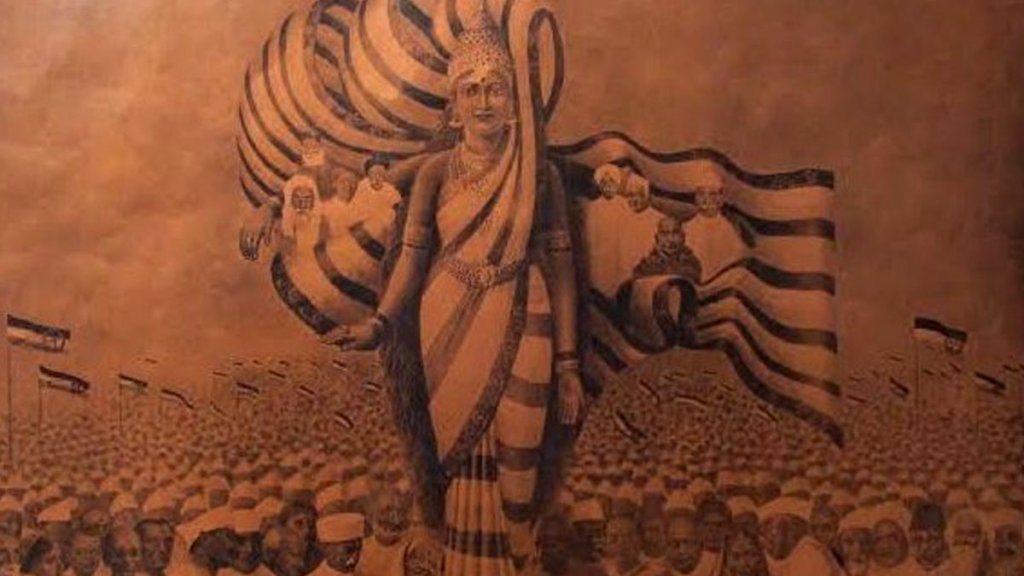
The female figure of India has various symbols that associate it with and promote a single religion and its traditional beliefs – Hinduism –such as it is always a Hindu goddess wearing a saree and heavy jewellery idealizing the way an ideal Hindu woman in the society should be dressed. It can be interpreted from her facial expressions that she is fierce, ferocious, and powerful but calm and domesticated at the same time. The wearing of ‘bindi,’ ‘sindoor,’ and ‘mangalsutra’ are the attributes that should be worn by married Indian women to appear respectable in the society. But more importantly, it domesticates their identity and objectifies them as it denotes that they are someone else’s property thereon. The use of upper-caste Hindu symbols like the saffron flag which itself is a representation of the growth and revival of Hindutva, along with the ferociousness of the lion can be said to depict the relationship amongst the people in the country. On one hand, it is depicted as an aristocratic Bengali married woman within heterosexual imagery by Abanindranath Tagore representing a giving mother figure, and on the other hand, in the Tamil schoolbook Puthiya Aarampakkalvit, it has a saree draped in the way South Indian women drape it, indicating how culturally diverse the country is. Gender is recruited in the position of nation-building and other intersections of caste, class and religion are supplementing the co-constitution of national figures that cannot be seen in isolation.
The idea of nation instrumentalized a woman’s body for masculinist, heterosexual reproduction of the idea of nation; it is highly caste coded and religiously determined. Not only is this female figure seen as the ‘birth-giver’ or the reproducing body that produces sons belonging to various cultures in order to ensure continuity but also imbibes love and care in the. It is depicted in the statements made by Nivedita Menon– “nation doesn’t need daughter, it needs daughter-in-law” and “Bharat Mata only bears sons, Sawarna sons, not daughters.” It is the role of this mother to reproduce men in order to protect the frontiers of this territory. It is also associated with notions of racial purity in an orthodox society like ours, where cows are worshipped and found ‘divine’ when alive, and when it is dead, people refuse to even carry its dead carcass, which then has to be taken care of by the caste labourers.
Jawaharlal Nehru had said, “If you educate a man, you educate an individual, if you educate a woman, you educate the entire family.” A pictorial representation on the cover of the Hindi book Ma ka Aahvaan by Dinanath Batra is that of a godly figure amidst a burning India, which shows that India is burning like a vicious volcano, and the mother is summoning the men to come to rescue her. This in a way promotes conjugality, fidelity, and materiality as the male members of the society are expected to rescue her. It gives out a message that she is not capable of protecting herself. On one hand, she is powerful and holds weapons showing that she is capable of a fight, but on the other, still endangered; it promotes a patriarchal mindset by limiting the role of women to giving birth and raising children. When they fight for rights within a nationalist project that excludes certain communities, their languages and cultures, a new nation-building practice is evoked. All goddesses, be it Laxmi, Durga or Saraswati, are used to denote Bharat Mata, but not Goddess Kali. The probable cause for the same can be the lack of care and homeliness in her nature, her independent attitude or her disobeying her husband. This is because Bharat Mata symbolizes the value system that is wanted by the women of the country to replicate and the virtues a good Indian woman should possess were missing in her. These idealized notions do not protect the women but the ideals, as an onus is put on the women to carry the ideals that the Bharat Mata is representative of, which in turn imprisons and restricts their behaviour and actions rather than empowering them.
Cows, in Hinduism, are given the holy designation of universal mother given their emotional and religious appeal. They are prayed and rites are performed on them at the same time, and hence required the protection of Hindus from other religions. On the other hand, these cows are slaughtered by Muslim butchers leading to various economic arguments. Another prominent example of casteism is when the ‘banjaras’ or ‘chamars,’ essentially the Dalits could not be employed in order to look after the cows or even be sold the cows. This is due to the prevalent untouchability in the society. The Hindi language is deemed to be sacred as it talks about female goddesses that are the symbols of power whereas Urdu and other ‘alien’ languages are bad and erotic. The idea of this language as a mother or wife has led to its gendering with the major use of ‘feminine’ words. However, instead of uplifting and promoting all religions, it just encourages and supports Hinduism, which leads to social and religious inequality.
Furthermore, the classification of India as Bharat Mata comes with the boundaries of the nation being thought of as the integrity of this mother. Any infiltration in the form of rape to women is directly seen as a language of humiliation, leading to violence around nations and national identity on the bodies of these women themselves. In a society like this, certain cultural and religious traits are picked up amongst the ones prevalent to become the national identity, and any deviation from it is seen as an anti-national statement and results in their exclusion. Inculcation of these kinds of sentiments promotes violence in itself. The nation represents a cultural iconography for which subscribers come from particular castes, religions, and class bearings, and constitute for women of the nation what they can or cannot be. The Mata is also sometimes seen as a metaphor for a fixed, bounded space, as she is enshrined within four walls, just in the way our country is limited by its boundaries. The temple comprises a stringent religious identity where people of all castes and classes could worship, and similarly, the idea of motherhood of the nation is what all sons of the mother should pray to.
Even though women and females are placed on a high pedestal by being worshipped, respected, and idealized, they are still shown as lacking strength and incapable of their own protection. The idealized notion, instead of empowering the women, cages their freedom, limits their choice and forces them to meet the expected standards of society by limiting their role in giving birth and raising children. Not only does this lead to the exclusion of other religions like Muslims and Christians instilling anti-national sentiments in the people which ends in violence.
Author’s Bio
Sunidhi Gupta is a student at Jindal Global Law School in her third year of BA. LLB (Hons.)
Image Source: https://www.herzindagi.com/hindi/society-culture/who-is-bharat-mata-article-202473
 NICKELED AND DIMED