
By Riya Lalchandani
Abstract
This article talks about the recent air pollution and haze prevailing in NYC in the context of its primary cause i.e., the Canadian wildfires. It also aims to address the question of environmental inequality and the disproportionate impact faced by minorities and low-income groups. Lastly, we analyse the impact at the ground level and look at possible solutions to prevent and control such environmental disasters from happening in the future.
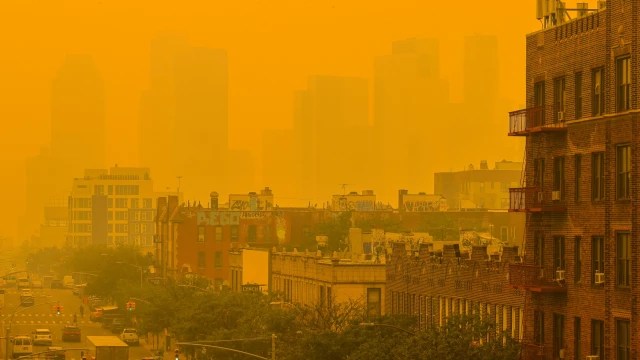
As of 7th June, New York City had the worst air quality among major cities. Social media posts and webcam footage revealed a reddish-orange tint in the sky over Manhattan, evoking parallels to Mars. The air quality index in New York City was over 200, which is considered to be “very unhealthy.” The National Weather Service has issued a Code Orange air quality alert for New Jersey and southeast Pennsylvania and Philadelphia region. This means that “vulnerable groups” such as children, the elderly, pregnant women, and those who have heart or respiratory conditions are at a high risk of exposure. On Tuesday, the amount of PM 2.5 in the air in New York City exceeded the WHO’s recommended level by more than ten times.
The Cause: Canadian Wildfires
The number of wildfires that have started in Quebec so far in 2023 is more than double what is expected for this time of year. This week alone, there are more than 150 active wildfires burning in Quebec. There have been about 9 million acres burned as a result of the Canadian wildfires.
The hot and dry conditions that encourage the start and spread of wildfires have been made worse by human-caused climate change. According to recent reports, the largest fossil fuel and cement producers in the world are responsible for the carbon pollution that has caused millions of acres of land to burn in the Western US and Canada, an area roughly the size of South Carolina. Additionally, when they burn, the smoke may be carried thousands of kilometres downstream, endangering millions more people.
This anticipated danger is becoming a reality as over the next few days, a cold front is expected to travel southwards and eastwards into the American mainland, driving smoke away from the currently affected cities of Boston, New England, and NYC, throughout the week. The smoke is being pumped south over the Great Lakes, Northeast, and Mid-Atlantic by a low-pressure system that is rotating anticlockwise over Nova Scotia and creating a conveyor belt of northerly winds.
Heat domes are large areas of high atmospheric pressure that trap and intensify the heat, often leading to extended periods of hot and dry weather conditions. These prolonged heat waves increase the risk of wildfires by drying out vegetation and creating favourable conditions for ignition and rapid fire spread. While wildfires can start in a variety of ways, how quickly they spread depends on how hot and dry the surrounding area is. The frequency and intensity of heat domes strongly correlate with climate change caused by human activities. This year, a number of high-end heat domes have contributed to wildfire outbreaks across Canada, and more seem to be on the horizon.
Addressing Environmental Injustice: Analysing the Disproportionate Impact of Air Pollution on Low-Income Communities in the Big Apple:
According to 2022 research from the Harvard T.H. Chan School of Public Health, certain groups are exposed to higher amounts of harmful fine particulate air pollution (PM2.5) than others, including Blacks, Asians, Hispanics, Latinos, and low-income communities. The black population had an average PM2.5 concentration in 2016 that was 13.7% higher than white people. Additionally, the PM2.5 concentration rose in a region as the Black population grew there. The Harvard team also found a “steep incline” for neighbourhoods with more than 85% Black residents and a similar pattern for regions with significant Hispanic and Latino populations.
According to the University of Michigan, industries that choose the least expensive route when determining where to establish hazardous waste sites and other polluting facilities “disproportionately target” minority and low-income neighbourhoods. Due to redlining, communities of colour, particularly Black communities, have historically been clustered near industrial infrastructure and in industrial zones. According to a UK study by Greenpeace and the Runnymede Trust, Black, Asian, and other minority populations of cities reside in “air pollution sacrifice areas.” These are locations where “access to green spaces and… infrastructure that produces a lot of pollution, such as recycling facilities, industrial sites, and incinerators.
American Healthcare: Adding fuel to fire?
According to studies, each American pays an additional $2,500 in medical expenses each year as a result of air pollution from fossil fuels, as climate change has a negative impact on both their health and their wallets.
According to the Natural Resources Defence Council (NRDC), air pollution costs the country more than $820 billion yearly and is responsible for an estimated 107,000 premature deaths.
According to the Asthma and Allergy Foundation of America, there are now 5.1 million children and 20 million people who have asthma in the United States. Untreated asthma claims ten American lives on average each day. The average uninsured cost of an inhaler can range from 80-500$, with an average annual cost of 3000 dollars per patient.
The total carbon footprint of the U.S. healthcare industry was assessed by Chung and Meltzer in 2009, highlighting the enormous contribution that healthcare makes to the physical economy of the nation. According to their findings, the healthcare sector accounts for 8% of the country’s greenhouse gas (GHG) emissions, with contributions coming from both direct and indirect activities connected to the supply chain for goods and services related to the healthcare sector (46%) and 54%, respectively. Significant portions of the nation’s air pollution emissions and effects, including acid rain (12%), greenhouse gas emissions (10%), smog formation (10%), criteria air pollutants (9%), stratospheric ozone depletion (1%), and carcinogenic and non-carcinogenic air toxics (1-2%), were also caused by the healthcare industry in 2013.
The Impact:
Even though it’s a fairly recent development one doesn’t need to be a rocket scientist to predict the impact. Now that the AQI in the Big Apple has overtaken Delhi’s air pollution levels and has caused the government to issue codes orange through purple, one can imagine how serious the situation is at the ground level.
It can be anticipated that the poor low-income groups will be the most affected as the high cost of healthcare combined with the low bargaining power of minimum wage workers with their employers is bound to put them at a higher risk of exposure to the hazardous fumes.
Patients with existing pulmonary and cardiovascular are at a higher risk along with some other vulnerable categories like pregnant women and children.
The smoke plumes on 6th June were thick enough to cause around 800 flights to get delayed owing to the poor visibility in certain regions. With the cold front moving the haze downwards, these conditions may be alleviated for the states closer, but regardless this will have a significant and lasting impact on not just the health but the economy as well of both Canada and America.
The Solution:
In conclusion, the early detection and prevention of heat domes play a crucial role in mitigating their impacts. Detection involves monitoring weather patterns and analyzing atmospheric pressure systems, which are achieved through the use of satellite data, weather models, and ground-based observations by meteorological agencies. By understanding these patterns, experts can anticipate the potential for prolonged heat waves and associated wildfire risks.
Addressing the root causes of climate change, particularly reducing greenhouse gas emissions, is essential in mitigating the frequency and intensity of heat domes. This can be achieved through transitioning to renewable energy sources, promoting energy efficiency, and adopting sustainable practices, all of which contribute to reducing the overall global warming effect.
Effective forest management practices are vital in reducing fuel loads and enhancing forest resilience against wildfires. These practices include a combination of traditional forest conservation methods, selective logging, thinning, and reforestation. Proper land stewardship and maintaining healthy forests contribute to mitigating the impacts of heat waves and subsequent wildfires.
Developing robust early warning systems that incorporate accurate weather forecasting and heatwave monitoring is crucial for effective prevention. Timely alerts allow authorities to implement preventive measures, such as fire restrictions and issuing public advisories about heat-related health risks, thus reducing the potential damages caused by heat domes.
Improving coordination between firefighting agencies is necessary to ensure a rapid and effective response to wildfires. The Canadian Interagency Forest Fire Centre (CIFFC) plays a significant role in facilitating interagency collaboration and resource sharing during large wildfires, enabling a coordinated response across provinces and territories.
To sum it all up, a comprehensive approach that encompasses early detection, climate change mitigation, forest management, warning systems, and coordinated firefighting efforts are essential in preventing and mitigating the impacts of heat domes. Implementing these measures is crucial for building resilience and ensuring a safer future in the face of extreme heat events and their associated risks.
About the author:
Riya Lalchandani is a 2nd-year BBA LLB student at JGLS with a keen interest in environmental law and conservation. She is a columnist at the Centre for New Economics Studies and writes research articles aimed at raising awareness about pressing environmental and social issues for their blog Nickled and Dimed. She is also a medical and nutritional facilitator at People for Animal Welfare (PAW) JGU. Her hobbies include volunteer work and reading.
Image Source: https://inews.co.uk/news/why-sky-orange-new-york-canadian-wild-fires-sky-2395882
 NICKELED AND DIMED